

Payroll services in London provide fully managed, outsourced payroll solutions designed to support businesses, particularly SMEs, with accurate payroll processing, statutory reporting, and regulatory compliance. These services cover end-to-end payroll administration, including PAYE, National Insurance, RTI submissions, workplace pensions, statutory payments, secure employee documentation, and specialised payment solutions, ensuring a reliable and compliant payroll process.
Outsourcing payroll enables London businesses to reduce administrative burden, strengthen compliance, and improve operational efficiency. By transferring payroll responsibilities to specialist providers, businesses gain access to expert knowledge, reduce compliance risk, and free internal resources to focus on growth, while maintaining scalability as the organisation evolves.
London payroll services operate under strict UK compliance frameworks, including PAYE, RTI, automatic enrolment, and employment law requirements. Providers are responsible for accurate reporting to HMRC, timely submissions, and adherence to employee entitlement regulations, helping businesses avoid penalties and maintain legal compliance.
The cost of payroll services in London varies based on business size and service scope, typically ranging from £2 to £25 per employee per month. Pricing models include fully managed, part-managed, and hybrid structures, allowing businesses to choose a cost-effective option aligned with their operational needs.
Choosing the right payroll service provider requires viewing the provider as a long-term strategic partner. Businesses should assess compliance capability, employee handling expertise, system integration, data security, pricing transparency, customer support quality, and scalability to ensure the payroll solution supports both current operations and future growth.
What payroll services does London offer for businesses?
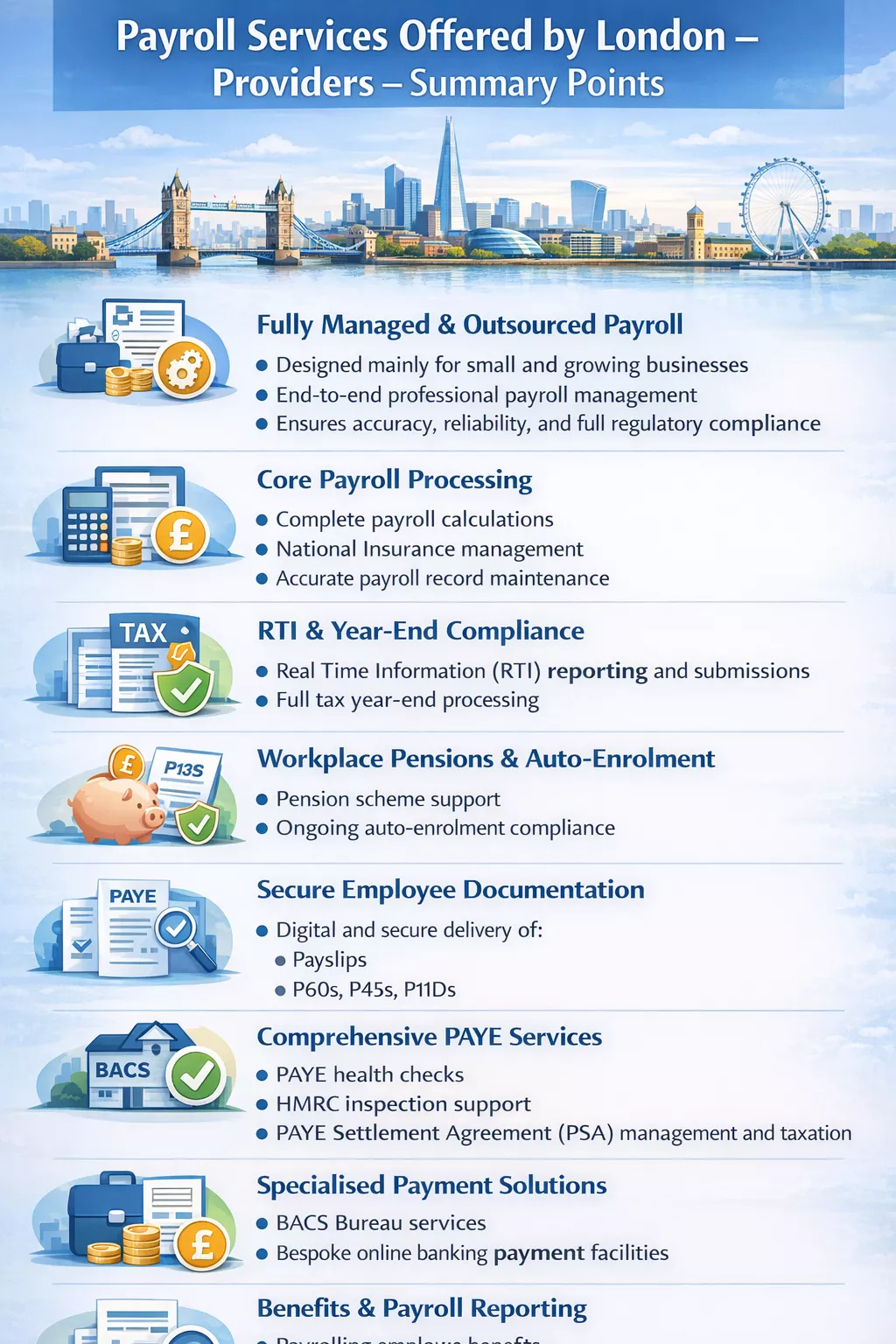
The payroll services offered by providers in London for businesses are comprehensive, specialising in completely managed, professional, and outsourced solutions tailored primarily for small enterprises to ensure full regulatory compliance and a trustworthy, hassle-free procedure.
Key aspects and specific services typically offered include:
- Complete payroll processing, including managing National Insurance and maintaining accurate payroll records.
- Real Time Information (RTI) reporting and submission, along with full tax year-end processing.
- Support for workplace pensions and auto-enrolment compliance.
- Secure delivery of essential documentation, such as payslips, P60S, P45S, and P11Ds.
- Comprehensive PAYE services, including health checks, inspection support, and the management and taxation of PAYE settlement agreements (PSAs).
- Handling specialised payment solutions, such as BACS Bureau or bespoke online banking facilities.
- Payrolling Benefits and providing detailed Payroll journals.
- Working with enhanced policies on statutory benefits, including maternity and sickness.
How do payroll services in London handle PAYE and HMRC reporting?
Payroll services in London handle PAYE and HMRC reporting by ensuring compliance with all relevant UK laws and regulations and managing comprehensive, accurate payroll processing for their clients. Their expertise ensures that all tax deductions and reporting requirements are met through efficient service delivery, including dedicated personalised support.
Specifically, these services manage the following key requirements for HMRC reporting:
- Handling PAYE management and ensuring all statutory tax deductions and payments comply with UK laws.
- Making mandatory Real-Time Information (RTI) submissions to HMRC.
- Navigating and accurately processing all necessary statutory payments and deductions, including specialised areas like the Employment Allowance and the Apprentice Levy.
How do London payroll services calculate statutory payments (e.g., SSP/SMP/SPP)?
London payroll services calculate statutory payments (e.g., SSP, SMP, SPP) by applying specialised expertise to ensure efficient and accurate payroll processing and full compliance with all relevant regulations. These comprehensive, fully managed services extend specifically to navigating statutory payments and deductions, such as the Apprenticeship Levy and Employment Allowance, seamlessly. By maintaining accurate payroll records, managing Real Time Information (RTI), and handling all aspects of payroll, including taxes, pensions, and National Insurance, providers ensure the calculation and administration of these statutory payments meet all relevant legal requirements and allow the business to remain compliant.
How do payroll providers in London process contractor and CIS payroll?
Payroll providers in London process contractor and CIS payroll by offering comprehensive, managed services that ensure regulatory compliance and efficient payment execution. Key ways they handle this specialised payroll include:
- Managing all aspects of payroll, including the calculation and processing of payments and handling National Insurance (NI) obligations.
- Ensuring the payroll is fully compliant with relevant laws and regulations concerning taxes, pensions, and other associated payroll costs and benefits.
- Maintaining accurate payroll records to meet all relevant regulatory requirements.
- Utilising secure payment processing methods, often as an approved BACS bureau that meets stringent standards, to facilitate faster and more secure processing of salaries, PAYE, third-party payments, and split payments.
Why should London businesses outsource payroll?
The reasons why London businesses, particularly SMEs, should outsource payroll are manifold, transitioning the function from an internal burden into a strategic decision that drives efficiency, safety, and long-term growth. Outsourcing provides a more cost-effective, safer, and efficient option than managing the process internally, offering several key advantages:

- Enhanced Compliance and Risk Management: Outsourcing strengthens regulatory compliance, improves accuracy, and removes internal pressure, thereby protecting the employees, the business, and its brand reputation in a city where high standards matter.
- Strategic Focus and Efficiency: It frees up directors and internal teams to focus on core parts of the business that actually drive growth, enabling better resource allocation rather than spending time on complex administrative duties.
- Scalability and Access to Expertise: Choosing a specialist payroll provider fosters seamless scalability, allowing the business to easily navigate growth challenges while providing crucial access to specialised expertise.
How does outsourcing payroll save time for London employers?
Outsourcing payroll saves time for London employers by eliminating the extensive administrative pressure on internal staff, allowing employees to focus on core business activities that promote productivity and innovation. By utilising specialised bureaus, employers can optimise resource allocation and focus their attention on achieving overarching business goals and objectives.
The specific ways time is saved include:
- Removing the necessity for internal staff to spend time figuring out complex changes in employment law.
- Eliminating time wasted on chasing details, managing confusion, and conducting after-hours administrative tasks related to payroll processing.
- Alleviating the overall time-consuming administrative burden, as employers simply send updates, and the specialists handle the remainder of the process entirely.
- Reducing internal overhead associated with training staff and managing software licensing within the accounting team.
How does outsourcing payroll reduce compliance risk in London?
Outsourcing payroll reduces compliance risk in London by shifting the responsibility from a reactive internal process to a proactive, specialist approach, thereby drastically mitigating the potential for oversight that leads to formal enquiries or penalties. Instead of trying to keep up with complex legislative updates internally, companies rely on providers whose sole focus is adherence to regulatory frameworks.
Specialist payroll providers reduce compliance risk through the following key mechanisms:
- Specialised Expertise: They employ dedicated professionals who focus solely on day-to-day payroll legislation, ensuring that compliance is their core competency, unlike general accountants who are trained primarily in broader tax and financial reporting.
- Proactive Regulatory Adherence: Providers remain constantly up-to-date with the latest UK legislation and compliance regulations, ensuring payroll processes adhere immediately to national law, preventing small oversights that result in penalties.
- Reduced Errors: Their specialised focus and established processes minimise the occurrence of critical errors, missed submissions, financial penalties, and potential employee disputes that arise from incorrect calculations.
- Robust Data Security: Reputable outsourced providers employ advanced data protection protocols and robust security measures, safeguarding sensitive payroll information from breaches and unauthorised access, which is crucial for data compliance.
How does payroll outsourcing cut costs compared to in‑house payroll?
Payroll outsourcing cuts costs compared to in-house payroll primarily by converting unpredictable internal expenses into a fixed, manageable investment and eliminating significant operational overhead. Outsourcing provides a clear and predictable cost structure, allowing businesses to pay a simple monthly fee for exactly the services required, rather than dealing with the varied and often hidden costs associated with maintaining an internal department.
Key specific expenses that are avoided through payroll outsourcing include:
- The costs associated with hiring, training, and retaining dedicated internal payroll staff.
- Investment in, and ongoing software licensing for, payroll infrastructure and specialised technology.
- The consumption of administrative time and internal overhead within the accounting team to manage the function.
- The unpredictable expenses related to keeping up-to-date with the latest regulatory changes and compliance mandates.
What compliance standards do London payroll services follow?
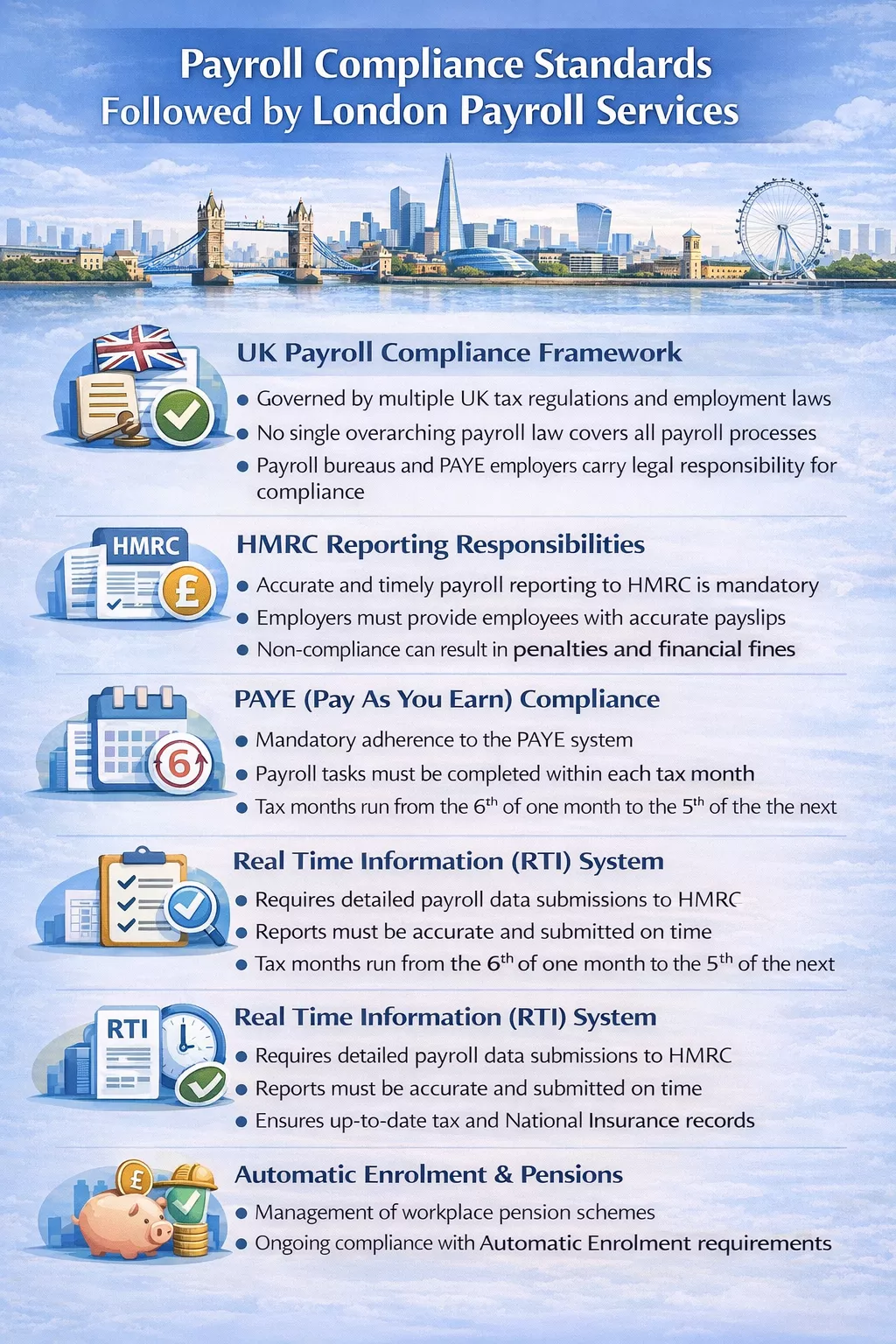
The compliance standards that London payroll services follow are governed by stringent UK tax regulations and multiple individual laws, as there is no single overarching payroll law covering all processes. Payroll bureaus and employers operating PAYE have a legal responsibility to submit accurate and timely reports to HMRC and provide employees with accurate payslips, as failing to comply with these regulations can result in penalties and fines.
Key compliance requirements and systems mandated for UK payroll services include:
- Adherence to the Pay As You Earn (PAYE) system dictates that certain payroll tasks must be completed during each tax month (running from the 6th of one month to the 5th of the next).
- Compliance with the Real Time Information (RTI) system requires the accurate and timely submission of detailed reports to HMRC.
- Management of employee pension schemes under the Automatic Enrolment requirements.
- Observance of individual laws related to employee entitlements, such as minimum wage requirements.
How do payroll services stay compliant with HMRC regulations?
Payroll services stay compliant with HMRC regulations by adhering to mandatory requirements, utilising specific reporting methods, and leveraging technology to ensure accuracy and timeliness in submissions:
- Fulfilling the legal requirement to register the business as an employer with HMRC.
- Reporting all employee pay and deductions to HMRC through the required mechanism, such as the Full Payment Submission (FPS).
- Using specialised payroll software to streamline and automate the process, which ensures the correct taxes are automatically calculated, deducted from employee pay, and submitted to HMRC in a timely manner, eliminating the risk of errors and non-compliance.
How do London payroll providers ensure data security and GDPR compliance?
London payroll providers ensure data security and GDPR compliance by adhering to stringent UK data protection laws and implementing appropriate security measures to safeguard sensitive employee data.
As legal entities, UK payroll bureaus must adhere to data protection laws, such as the General Data Protection Regulation (GDPR) and the Data Protection Act (DPA). These regulations require the implementation of various compliance measures and the use of secure systems—like dedicated payroll software—to keep employee records safe. Failure to comply with these requirements can result in significant penalties and fines.
Specifically, under GDPR and DPA, providers have a legal responsibility to perform several key actions:
- Obtain explicit employee consent for the processing of personal data.
- Maintain comprehensive records detailing all data processing activities.
- Implement appropriate technical and organisational security measures to protect employee data from unauthorised access or breaches.
How do payroll services handle UK payroll legislative updates?
Payroll services handle UK payroll legislative updates primarily through proactive maintenance, expert knowledge, and specialised technology, which is crucial for ensuring constant compliance with continually changing laws and HMRC regulations. Professional managed services often utilise CIPP-qualified teams who offer expert support, ensuring the business complies with all relevant legislative requirements. Furthermore, these services employ specialised software solutions that are regularly updated to stay current with evolving compliance requirements. This ongoing vigilance is necessary because employers operating PAYE must complete certain compliance tasks continuously, as UK tax months run from the 6th of one month to the 5th of the next.
How much do payroll services in London cost?
The cost of payroll services in London, similar to the wider UK market, varies widely depending on the business size, payment frequency, and the specific scope of services required, but typically falls between £2 and £25 per employee per month. For smaller operations, general estimates suggest paying between £20 and £50 per month for a team of five employees paid monthly.

Pricing structures often follow different service tiers based on the level of management provided, which generally include:
- Fully-Managed Service: This comprehensive option often starts at approximately £4 to £6 per employee per month.
- Part-Managed Service: This less comprehensive option typically costs around £2 to £3 per employee per month.
- Administrative/Hybrid Structure: Some firms utilise a structure combining a fixed administration charge (e.g., £20 per month for small business payroll) plus a variable fee per payslip (e.g., £5 per employee per payslip, whether weekly or monthly). This model often means the employer remains responsible for arranging and making the final payments of net salary and deductions (HMRC, pensions, benefits).
What pricing models do London payroll providers use (per slip, fixed fee)?
The pricing models London payroll providers use generally revolve around per-payslip or per-employee rates, or fixed monthly fees, with the cost dependent on the service scope.
For transaction-based pricing, the cost of outsourcing payroll in the UK typically ranges between £5 and £10 per payslip or between £2 and £25 per employee per month.
Alternatively, providers use fixed-fee structures, which are often tailored to the client’s specific requirements. These agreed fixed fees frequently cover all client communication and liaison with HMRC to avoid unexpected costs. The level of service determines the price, with fully managed services costing more than part-managed options.
A fully managed service often costs roughly £25 to £50 per month in total or generally starts at around £4 to £6 per employee per month. If the client uses a part-managed option and manages specific elements of the payroll themselves, such as paying staff, the cost may be lower, at around £2 to £3 per employee per month.
What factors influence payroll service pricing in London (team size, frequency)?
The factors influencing payroll service pricing in London, which is typically structured on a per-employee-per-month (PEPM) basis, are influenced by several key elements:
- Team Size (Business Size): Payroll services predominantly charge a per-employee fee (PEPM). Naturally, a business with a larger number of employees will incur a higher overall cost to outsource its payroll. However, some providers offer cheaper per-employee rates to businesses with larger volumes of staff.
- Scope and Level of Management: The complexity and extent of the services provided determine the final price. A fully-managed payroll service is typically more expensive, often starting around £4 to £6 per employee per month, while a part-managed option may cost less, often around £2 to £3 per employee per month. Clarifying the exact scope of services and agreeing on fees upfront prevents surprises and ensures accurate budgeting.
- Pricing Range: The typical cost for outsourced payroll tasks in the UK ranges widely, from £2 up to £25 per employee per month, depending heavily on the service scope, whether it is fully-managed or part-managed, and the overall volume of employees.
What additional fees might London payroll services charge (setup, reports)?
The additional fees that London payroll services might charge, covering setup, reporting, and other administrative tasks, include the following categories:
- Initial Setup and Scheme Creation: Setup fees vary significantly, ranging from zero to £2 per employee. Providers who charge a flat rate often fall within a range of £100–£1,000, although some specific initial payroll scheme setups may be lower, such as £80.
- Pension and Auto-Enrolment Administration: While some fully managed payroll services include auto-enrolment as standard, others charge around £1.50–£2 per employee, either per month or as a one-off administrative cost. Additionally, a one-off fee for setting up the Workplace Pension Scheme specifically may cost around £450.
- Specific Forms and Reporting: Fees are charged for submitting mandatory forms like a P11D, which may be £50 per employee.
- Non-Standard Administrative Tasks: Providers may charge specific fees for services outside standard processing, such as a late filing penalty appeal, costing around £30 per appeal.
- Add-on HR Services: If the client requires integrated HR services alongside payroll, budgeting for a typical fee of £10–£25 per employee per month is necessary.
How do you choose the right payroll service provider in London?
The process of choosing the right payroll service provider involves recognising the provider as a strategic, long-term business partner, clearly defining both short- and long-term company objectives, and establishing a rigorous checklist to evaluate vendors. Making an informed decision is crucial because payroll involves more than just paying employees; it includes ensuring strict compliance with regulations, handling tax filings, and maintaining accurate records, all of which are essential for running the business smoothly.

When selecting a payroll service provider, businesses should carefully consider the following essential factors:
- Compliance and Regulations: Verify the provider’s capability to ensure full compliance with all UK laws and regulations.
- Employee Handling: Confirm their ability to accurately manage and handle different types of employees and complex contract structures.
- Integration: Assess the provider’s technology for seamless integration with existing accounting software.
- Data Security and Privacy: Evaluate the measures they have in place for data security and privacy to protect sensitive business and employee information.
- Cost and Pricing: Determine the cost structure and pricing model to ensure it fits the business budget.
- Customer Support: Assess the quality and responsiveness of customer support and service.
- Technology and Scalability: Ensure their technology platform can support the company’s strategic growth and future needs, making implementation and adoption easier.
What business sizes can London payroll services support?
The business sizes that London payroll services can support are typically a wide range, often encompassing organisations from small businesses to large international enterprises. Providers have extensive experience serving a wide range of clients and offer services that are designed to be scalable. This scalability is reflected in pricing models, which often charge based on factors such as the number of employees and the frequency of payroll processing. Additionally, many services, such as Brain Payroll UK, offer customizable options, including the ability to add multiple pay rates for different employees and automated processing features like P60 generation, allowing businesses of varying sizes and complexities to tailor the service to their specific needs and ensure compliance and accuracy.
What features should London businesses prioritise in a payroll provider?
The features that London businesses should prioritise in a payroll provider are those that ensure strict compliance with UK regulations, enhance operational efficiency, and offer robust core functionality to support the entire workforce:
- UK Compliance and Tax Filing: The provider must ensure absolute compliance with all UK laws and regulations, including accurate calculation of taxes, handling necessary withholdings, and managing comprehensive tax filing services to keep the business compliant.
- Core Payroll Processing and Accuracy: This includes the ability to calculate wages accurately and in a timely manner for different types of employees, process payments efficiently, and offer convenient options like direct deposit.
- Integration and Automation: Prioritise providers that offer seamless integration with existing accounting and HR systems to streamline operations. This integration is key to maximising team performance, boosting staff engagement, and providing visibility for spend and cost reduction across the business.
- Employee Self-Service (ESS): A comprehensive package should include an ESS portal where employees can easily view their payments and tax documents, update personal information, and receive support through every step of the employee life cycle.
- Data Security and Privacy: Given the sensitive nature of payroll information, the provider must offer strong data security and privacy measures.
- Support Structure and Cost: Reliable customer support and service are essential for addressing any payroll issues or questions that arise, and the overall cost and pricing structure must be evaluated to ensure the solution is financially viable.
What payroll software and systems do London providers integrate with?
The payroll software and systems that London providers integrate with generally include major platforms necessary for comprehensive financial and human resource management.
- Accounting Software: Providers should integrate with common accounting platforms, such as Xero, to ensure seamless data transfer between the systems for managing overall business finances.
- Human Capital Management (HCM) Software: Integration with HCM software is crucial for assisting digital transformation initiatives and enabling business continuity plans.
- Internal Integrated Components: While integration with external systems is vital, a comprehensive payroll package must also internally integrate core components such as detailed Payroll Processing (calculating wages and taxes), comprehensive Tax Filing Services, Direct Deposit functionality, and Employee Self-Service portals for viewing payments and updating personal information.


