
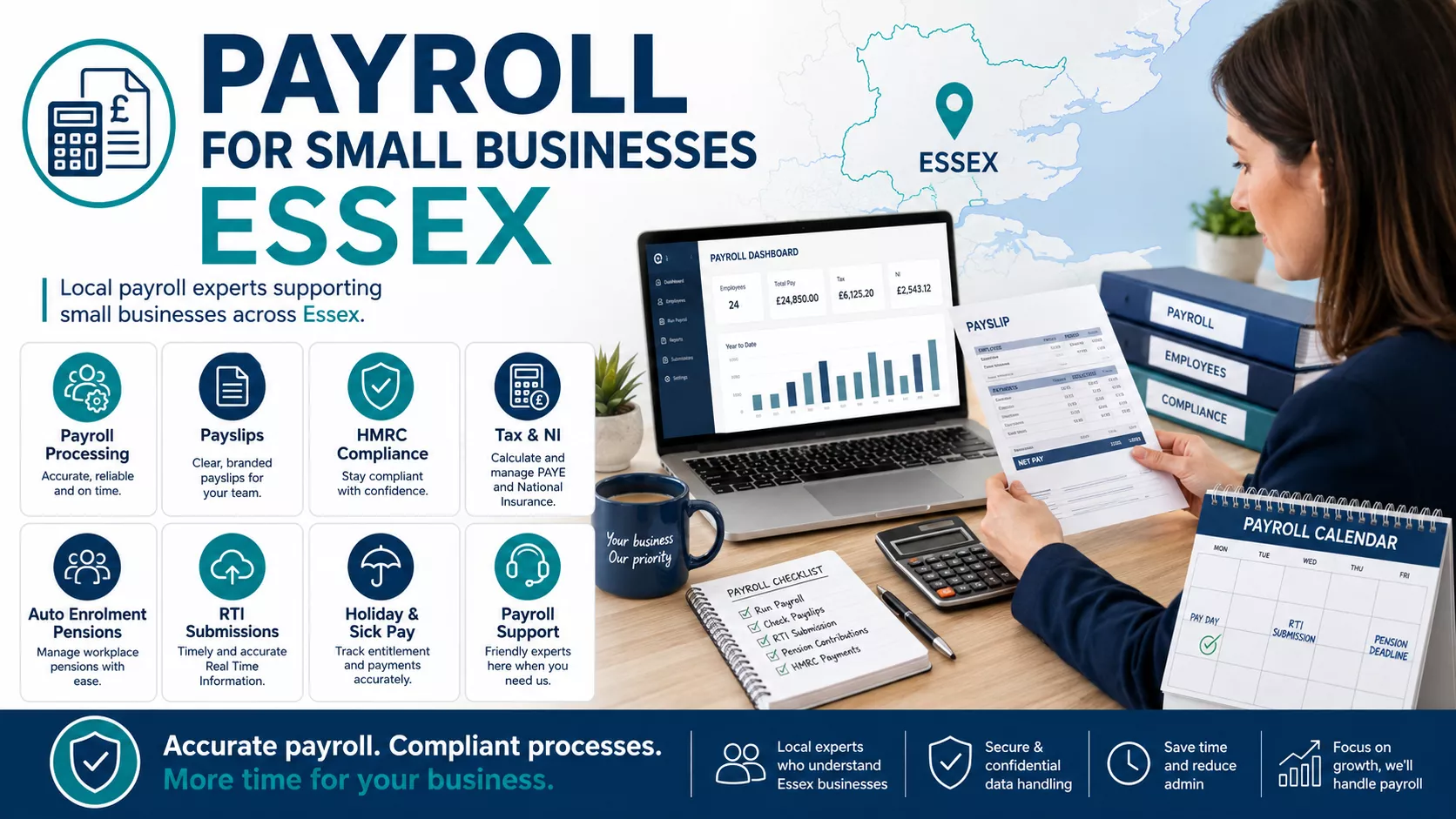
Managing payroll for a small business in Essex involves calculating employee pay, applying PAYE Income Tax and National Insurance deductions, managing workplace pensions, producing payslips, reporting information to HMRC and paying staff correctly and on time. Good payroll management supports compliance, cash-flow control and employee trust, while reducing the risk of costly errors.
The process usually begins with registering as an employer with HMRC and obtaining the required PAYE references. Businesses then need suitable payroll software, accurate employee details and a reliable system for calculating gross pay, overtime, bonuses, pensions, student loan deductions and net pay. Employers must issue payslips, submit payroll information through Real Time Information using a Full Payment Submission, and make PAYE payments to HMRC within the required deadlines.
Small businesses must also meet wider payroll obligations covering minimum wage rules, workplace pensions, holiday pay, statutory payments and record keeping. Common mistakes include using the wrong employment status, relying on outdated employee information, missing RTI deadlines, making incorrect deductions and failing to maintain a clear payroll audit trail.
As a business grows, payroll can become increasingly time-consuming. Outsourcing payroll services in Essex can reduce administration, improve accuracy and provide access to specialist knowledge. Choosing a provider with strong SME experience, secure technology, responsive support, transparent pricing and up-to-date UK payroll expertise can help businesses manage payroll more efficiently and focus on growth.
How Does Small Business Payroll Work in Essex?
Running payroll for a small business in Essex means calculating employee pay, applying the correct Income Tax, National Insurance, pension and other deductions, producing payslips, reporting payroll information to HM Revenue & Customs (HMRC), and paying employees accurately and on time.
Most employers operate payroll through PAYE (Pay As You Earn) using HMRC-compatible payroll software. Payroll information is normally reported through Real Time Information (RTI) by submitting a Full Payment Submission (FPS) on or before payday. Your PAYE bill is then generally due to HMRC by the 22nd of the following tax month when paying electronically.
For an Essex business with only a few employees, payroll may initially seem manageable. However, tax codes, National Insurance, workplace pensions, statutory payments, starters, leavers and changing wage rates can quickly make the process more demanding. Reliable payroll software or professional payroll services in Essex can therefore reduce administrative work and lower the risk of costly errors.
Why Is Payroll Crucial for Your Small Business in Essex?
Payroll is more than transferring salaries into your employees' bank accounts. It connects employment records, tax, pensions, cash flow and legal compliance.
Every pay period, an employer may need to calculate wages, bonuses, overtime and deductions before reporting the correct figures to HMRC. Mistakes can affect employees' take-home pay, HMRC records and the amount the business owes.
Good payroll management in Essex therefore helps your business achieve three important things: employees receive the correct amount on time, HMRC receives accurate payroll information, and management has a reliable record of employment costs.
It also supports employee trust. A worker who repeatedly receives an incorrect payslip or late salary is unlikely to view payroll as a minor administrative issue.
What Does Payroll Involve?
Payroll is the system a business uses to calculate, record and distribute employee pay while meeting its tax and employment obligations.
For most small employers, payroll involves several connected activities.
- Recording salaries, hourly wages, overtime, bonuses and commissions.
- Calculating gross pay for each employee.
- Deducting PAYE Income Tax and employee National Insurance where applicable.
- Calculating employer National Insurance.
- Processing workplace pension contributions.
- Applying student or postgraduate loan deductions where instructed.
- Accounting for statutory payments and certain employee benefits.
- Producing payslips.
- Reporting pay and deductions to HMRC.
- Paying employees their net wages.
- Maintaining payroll records.
HMRC states that employers using PAYE must record employee pay, calculate deductions, produce payslips and report pay and deductions through an FPS.
The challenge is that one payroll calculation can influence several other records. An incorrect tax code, for example, can result in the wrong Income Tax deduction, incorrect net pay and inaccurate information being reported to HMRC.
How to Set Up Payroll for a Small Business in Essex
The following seven-step process provides a practical framework for businesses running payroll for the first time.
Step 1: Register as an Employer With HMRC
If you start employing staff, you will normally need to register as an employer with HMRC.
Registration should take place before your first payday so that you can obtain your employer PAYE reference. HMRC states that businesses generally cannot register more than two months before they start paying employees. A limited company may also need to register where the only person being paid is its sole director.
The rules can differ depending on your business structure and employment arrangements, so do not assume that being a small business or employing only one person removes your PAYE responsibilities.
Once registered, keep your PAYE reference and Accounts Office reference secure because they will be needed when operating and reporting payroll.
Step 2: Choose Payroll Software or a Payroll System
Running payroll manually increases the opportunity for calculation and reporting errors.
Payroll software can calculate PAYE and National Insurance, maintain employee records, generate payslips and submit payroll information electronically to HMRC.
Common options used by UK businesses include platforms such as:
- Xero Payroll
- Sage Payroll
- QuickBooks Payroll
- Other HMRC-recognised payroll software
Cloud-based systems can be particularly useful for small businesses because payroll information can be accessed securely from different locations and updated without maintaining a traditional desktop installation.
However, software does not remove the employer's responsibility for providing accurate information. Incorrect hours, tax codes or employee details entered into good software can still produce an incorrect payroll.
Step 3: Collect the Correct Employee Information
Before adding someone to payroll, collect enough information to identify them correctly and calculate their tax position.
Typical information includes:
- Full legal name
- Home address
- Date of birth
- National Insurance number
- Employment start date
- Salary or hourly rate
- Normal working hours
- Bank details
- P45 information from their previous employment, where available
- Student or postgraduate loan information where relevant
A P45, rather than a P60, is normally important when somebody starts a new job because it contains information from their previous employment.
If the employee does not have a P45, HMRC's Starter Checklist can be used to collect the information needed to establish the appropriate starting tax treatment.
Accurate starter information is particularly important because errors made during onboarding can continue through several payroll periods before being discovered.
Step 4: Calculate Earnings and Payroll Deductions
Start by establishing the employee's gross pay.
Depending on the employment arrangement, this could include basic salary or hourly wages plus additional payments such as overtime, commission, bonuses or certain taxable benefits.
The payroll system then calculates applicable deductions, which may include:
- PAYE Income Tax
- Employee National Insurance
- Workplace pension contributions
- Student or postgraduate loan repayments
- Other authorised deductions
The employer may also have additional costs that do not simply come out of the employee's take-home pay, such as employer National Insurance and employer pension contributions.
Tax calculations should use the employee's current tax code and the appropriate HMRC rates and thresholds for the relevant tax year.
For the 2026/27 tax year, HMRC publishes the applicable PAYE and National Insurance thresholds for employers and confirms that payroll software normally calculates the deductions.
Step 5: Produce and Issue Payslips
Employees and workers must receive a payslip on or before payday.
At a minimum, a payslip should show gross pay, deductions such as tax and National Insurance, and net pay. Where pay varies according to time worked, it must also show the number of hours worked.
Payslips can be provided electronically or in printed form.
A clear payslip makes it easier for employees to understand:
Gross pay → deductions → net pay
Providing understandable payroll information can also reduce routine queries from staff about tax, pension contributions and deductions.
Step 6: Report Payroll to HMRC and Pay What You Owe
One of the most important areas of payroll processing in Essex is correctly separating two deadlines that are often confused.
First, you normally submit a Full Payment Submission (FPS) to HMRC on or before the employee's payday. The FPS tells HMRC what the employee has been paid and what deductions have been made.
Second, you pay the PAYE amount owed to HMRC. For employers paying monthly, electronic payment is normally due by the 22nd of the following tax month. If paying by cheque through the post, HMRC must normally receive the payment by the 19th.
If no employees are paid during a tax month, an Employer Payment Summary (EPS) may be required instead.
Missing reporting or payment deadlines can lead to warnings, penalties or interest, so payroll should have a documented monthly timetable rather than relying on memory.
Step 7: Pay Your Employees
After deductions have been calculated and payroll has been checked, transfer each employee's net pay using the agreed payment method, normally bank transfer.
Before releasing payments, compare:
Payroll report → payslip → bank payment
The amounts should match.
It is worth introducing an approval step even in a very small business. A second review can catch duplicate payments, missing overtime, unusual deductions or incorrect bank details before money leaves the account.
What Payroll Compliance Requirements Must Essex Businesses Follow?
There is an important distinction for local businesses to understand: Essex does not operate a separate PAYE tax system.
Businesses in Chelmsford, Colchester, Brentwood, Basildon, Braintree and elsewhere in Essex generally follow the same relevant UK payroll and employment rules as other employers operating under the same jurisdiction.
Local knowledge can still be valuable when choosing an accountant or payroll provider, but there are no special "Essex PAYE rates" simply because your business is based in Essex.
National Minimum Wage and National Living Wage
Employers must ensure eligible workers receive at least the applicable statutory minimum.
From 1 April 2026, the National Living Wage for workers aged 21 and over is £12.71 per hour. The rate is £10.85 for those aged 18–20 and £8.00 for eligible under-18s and apprentices.
Minimum wage compliance requires more than entering the correct hourly rate. Certain deductions and unpaid working time can still result in an underpayment.
Workplace Pensions
Automatic enrolment should also be built into the payroll process.
Employers generally need to automatically enrol eligible workers aged between 22 and State Pension age who earn at least £10,000 per year and ordinarily work in the UK.
Payroll therefore needs to communicate accurately with your workplace pension arrangements.
Holiday and Statutory Pay
Most workers are entitled to 5.6 weeks of paid statutory holiday each year, although the calculation can differ for part-time, irregular-hours and part-year workers.
Payroll may also need to handle statutory payments relating to sickness, maternity, paternity, adoption and other eligible leave.
Payroll Record Keeping
HMRC requires employers to keep payroll records such as employee payments, deductions, HMRC reports, HMRC payments and tax-code notices for three years from the end of the tax year to which they relate.
There is an important exception worth knowing: minimum-wage records created under the current rules generally need to be retained for at least six years.
This is one reason a well-organised digital payroll archive is useful.
What Are the Most Common Small Business Payroll Mistakes?
Many payroll errors are not caused by complicated tax planning. They come from small administrative mistakes repeated each month.
Using the Wrong Employment Status
An employee, worker, contractor and genuinely self-employed individual are not automatically treated the same way.
Incorrectly treating someone as self-employed simply because they invoice the business can create tax and employment-law problems.
Employment status should therefore be assessed based on the actual working relationship rather than the label used in a contract.
Using Outdated Employee Information
Tax codes, addresses, salaries, working patterns, pension status and student loan instructions can change.
Create a process for updating payroll whenever HR or employment information changes.
Missing RTI Deadlines
Do not confuse the date employees are paid with the date the PAYE bill is paid to HMRC.
The FPS is generally due on or before payday, while the monthly PAYE payment will normally be due later. Late FPS submissions may result in warnings or penalties.
Making Incorrect Deductions
Payroll software can automate calculations, but it cannot always identify incorrect source data.
Review unexpected changes in:
- Income Tax
- National Insurance
- Pension deductions
- Student loan deductions
- Net pay
Large differences from the previous payroll period should be investigated before payroll is approved.
Failing to Keep a Payroll Audit Trail
A business should be able to explain how each payroll figure was produced.
Keep organised records of pay, deductions, changes, approvals, HMRC submissions and payments rather than relying only on a bank statement.
Should a Small Business in Essex Outsource Payroll?
For many growing businesses, outsourced payroll in Essex becomes attractive when payroll administration begins taking management time away from customers, staff and business development.
Outsourcing can provide several practical benefits.
Less Administration
Instead of calculating payroll, monitoring changes and preparing submissions internally, much of the recurring work can be handled by a payroll specialist.
Better Access to Payroll Knowledge
UK payroll rules and rates change over time. A specialist provider should have processes for keeping systems and calculations aligned with current requirements.
Reduced Risk of Errors
Professional payroll processing can introduce structured checks, reporting procedures and deadline monitoring.
Outsourcing does not remove every responsibility from the employer, however. You still need to provide correct employee information and approve payroll where required.
More Time for the Business
For a small business owner, two or three hours spent resolving payroll problems each month can become a high annual cost.
Professional payroll services in Essex can allow owners and managers to spend more time on customers, operations and growth.
How Do You Choose a Payroll Service Provider in Essex?
Price matters, but it should not be the only factor.
Before choosing a provider, assess several areas.
- Small-business experience: Do they regularly manage payrolls of a similar size and complexity?
- UK payroll knowledge: Can they handle PAYE, RTI, National Insurance, pensions, statutory payments, starters and leavers?
- Technology: Do they use secure, modern payroll systems?
- Data protection: How is confidential employee information stored and transferred?
- Support: Can you reach someone quickly when an employee or payroll issue needs attention?
- Deadlines: Who is responsible for supplying information, approving payroll and submitting reports?
- Pricing: Are setup fees, year-end work, pension processing and additional payroll runs included?
- Scalability: Can the service grow with you if your workforce expands?
A provider's location can make communication easier, but expertise matters more than postcode. An Essex payroll provider should understand the needs of local SMEs while applying the correct UK payroll and employment rules, rather than claiming there are separate Essex tax laws.
Small Business Payroll Checklist
Before approving each payroll run, use a short control checklist to reduce avoidable errors.
- Confirm starters and leavers.
- Check salary, hours, overtime and bonuses.
- Update tax codes and payroll notices.
- Review pension changes.
- Check statutory or other absence-related payments.
- Review unusual deductions.
- Produce payslips.
- Check the FPS before submission.
- Reconcile net payroll with the bank payment.
- Record the amount due to HMRC.
- Save payroll reports and supporting records securely.
A consistent process makes payroll easier to review, delegate and outsource as your business grows.
Final Thought
Payroll may look straightforward when your business employs only one or two people, but each new employee can introduce additional calculations, records, pension duties and reporting responsibilities.
A reliable process starts with registering correctly with HMRC, choosing suitable payroll software, maintaining accurate employee information, calculating earnings and deductions, producing compliant payslips, submitting RTI information on time and maintaining a clear audit trail.
As the business grows, outsourcing can become a practical alternative to managing every payroll task internally.
Professional payroll services in Essex can help small businesses reduce administration, improve payroll accuracy and stay on top of PAYE, National Insurance, pensions and HMRC reporting requirements.
Need help managing payroll for your Essex business? Arrange a free payroll consultation to discuss your current payroll process, identify areas that could be simplified and explore whether outsourced payroll is right for your business.
FAQs
Do small businesses in Essex have to register for PAYE?
Usually, if your business employs staff and needs to operate PAYE, you must register as an employer with HMRC before the first payday. The exact requirement depends on how and whom you employ.
When must payroll be submitted to HMRC?
A Full Payment Submission is normally sent to HMRC on or before the date employees are paid.
When does an employer pay PAYE to HMRC?
Monthly PAYE bills are normally due by the 22nd of the following tax month when paying electronically, or by the 19th where payment is made by cheque through the post.
How long should payroll records be kept?
General PAYE payroll records normally need to be kept for three years from the end of the relevant tax year. Some records have longer requirements; minimum-wage records, for example, generally need to be retained for at least six years under current rules.
Can I run payroll myself?
Yes. Many small businesses manage payroll internally using HMRC-compatible payroll software. However, the employer remains responsible for accurate employee data, deductions, reporting and payments.
Do I need payroll software for one employee?
A very small workforce does not remove payroll obligations. Suitable software can make PAYE calculations, RTI reporting and record keeping much easier, even when only one or two people are paid.
What happens if I make a payroll mistake?
The appropriate correction depends on the type and timing of the error. HMRC advises employers who identify errors in an FPS to submit corrected payroll information as soon as possible.
Is outsourcing payroll worth it for a small business?
It can be particularly valuable when payroll takes too much management time, the workforce is growing, calculations are becoming more complex or the business wants additional specialist support with compliance.
Are payroll laws different in Essex?
Generally, no. PAYE, National Insurance and the main statutory payroll requirements are set nationally rather than by Essex councils. The value of choosing an Essex payroll provider is mainly local business knowledge, accessibility and support.


