
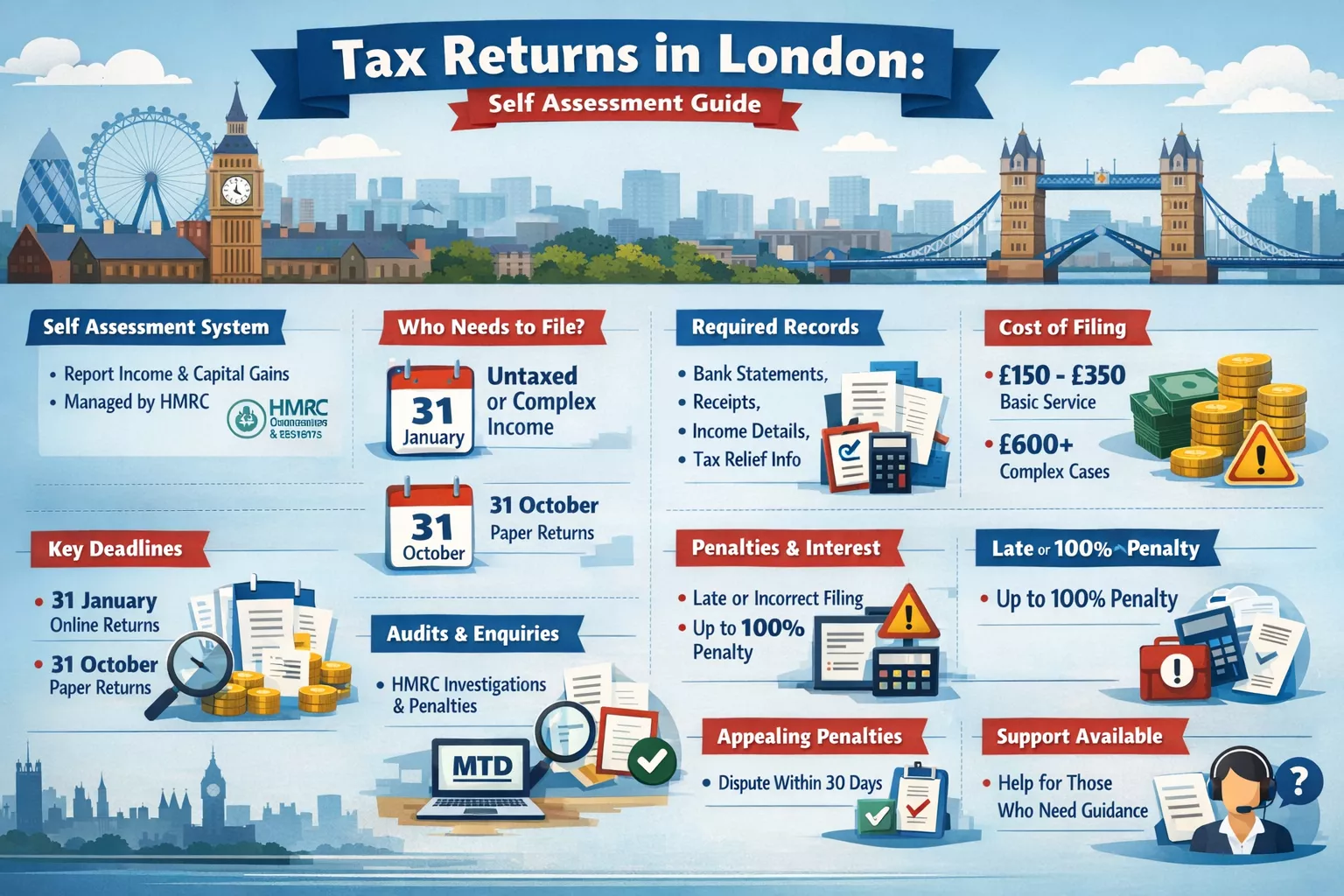
A tax return in London, specifically through the Self Assessment system managed by HM Revenue and Customs (HMRC), is the official method for reporting income and capital gains to determine tax liabilities. The system is necessary because income from wages and pensions is taxed automatically, but other untaxed income must be reported by individuals and businesses through Self Assessment.
Key deadlines for filing tax returns are 31 January for online returns and payments, and 31 October for paper returns. Missing these deadlines can result in penalties and interest. To prepare a tax return in London, taxpayers need essential records such as bank statements, receipts, income details, and information on tax relief claims. This ensures an accurate and efficient filing process.
The cost of filing a tax return in London generally ranges from £150 to £350 for a basic service, but can increase to £600 or more for more complex situations, such as those involving varied income or complicated business structures. Late or incorrect filings can lead to penalties and interest charges from HMRC. Penalties vary depending on the type of tax, and interest is applied to outstanding payments, which can be avoided by paying promptly.
HMRC enquiries and audits can create stress and lead to significant financial penalties, particularly for self-employed individuals involved in fraudulent activities. Penalties can reach up to 100% of the tax owed in severe cases. Taxpayers can correct returns or appeal penalties by disputing decisions with HMRC within 30 days, providing clear reasons and supporting evidence for their claims.
Some London residents might not need to file a tax return if their income is taxed through PAYE. Only those with untaxed or complex income need to file a Self Assessment. Future policies like Making Tax Digital (MTD) will require certain individuals to keep digital records and submit quarterly returns, starting from April 2026, depending on income levels.
Help and support for tax returns in London are available, especially for those who cannot afford professional advice. This assistance can help with understanding tax issues and completing returns, offering peace of mind for taxpayers.
What is a tax return and how does Self Assessment work in London?
A tax return, specifically the Self Assessment tax return system managed by HM Revenue and Customs (HMRC), is the official method for reporting income and capital gains to determine tax liabilities. Self-assessment is the way individuals and businesses work out what they owe to HMRC on their total income, including income that has not been taxed at source.
The Self Assessment system is necessary because tax is usually deducted automatically from wages and pensions, meaning that income is taxed at source. However, people and businesses with other income, income that has not been taxed automatically, must report it in a Self Assessment tax return. This process requires the filer to include all income and capital gains so that HMRC can calculate the final tax owed.
When are the key deadlines for filing tax returns in London?
The key deadlines for filing tax returns under the UK's Self Assessment system (which applies in London) typically occur annually on the following dates:
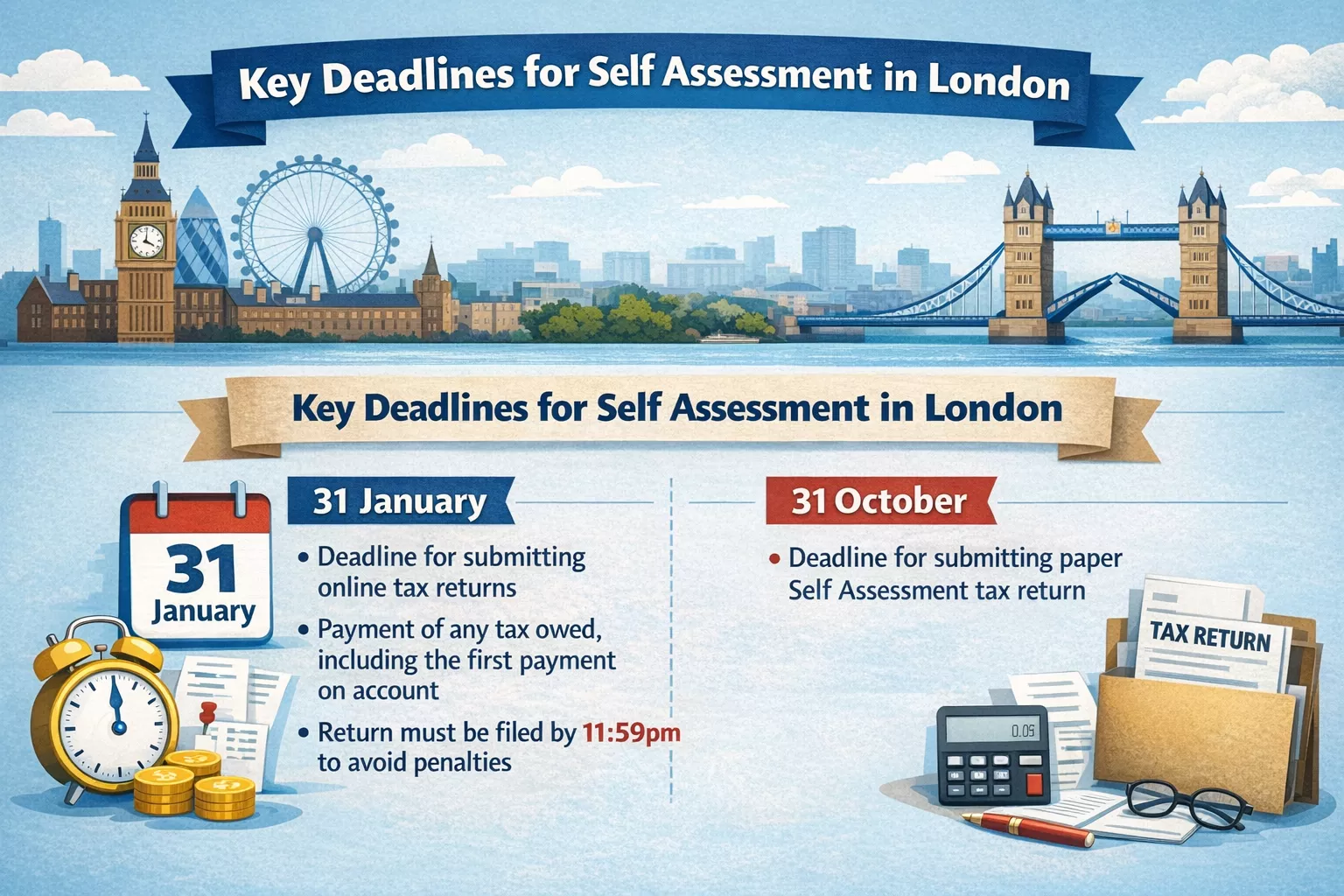
- 31 January: This is the standard deadline for submitting online tax returns. Returns must be filed by 11:59 pm to avoid a late filing penalty. This deadline also applies to the payment of any tax owed, including the first payment on account, for individuals, trusts, and partnerships.
- 31 October: This is the annual deadline for submitting a paper Self Assessment tax return.
What documents and information do you need to prepare a tax return in London?
The documents and information you need to prepare a tax return in London, particularly for the UK Self Assessment system, involve keeping detailed records and providing specific financial data points required by the basic SA100 form.
To complete your tax return correctly and efficiently, the following information and records should be prepared:
- Essential records and proof of transactions, such as bank statements or receipts, must be kept so you can fill in your tax return correctly.
- Detailed information regarding your total income.
- Details regarding any main tax reliefs you wish to claim.
- Your preference on how you would like to deal with any resulting tax payment or refunds.
How much does it cost to file a tax return in London and what are the common service options?
The cost to file a tax return in London, specifically for an annual self-assessment, typically ranges between £150 and £350 for a basic service, though fees can climb to £600 or more depending on complexity and scope.
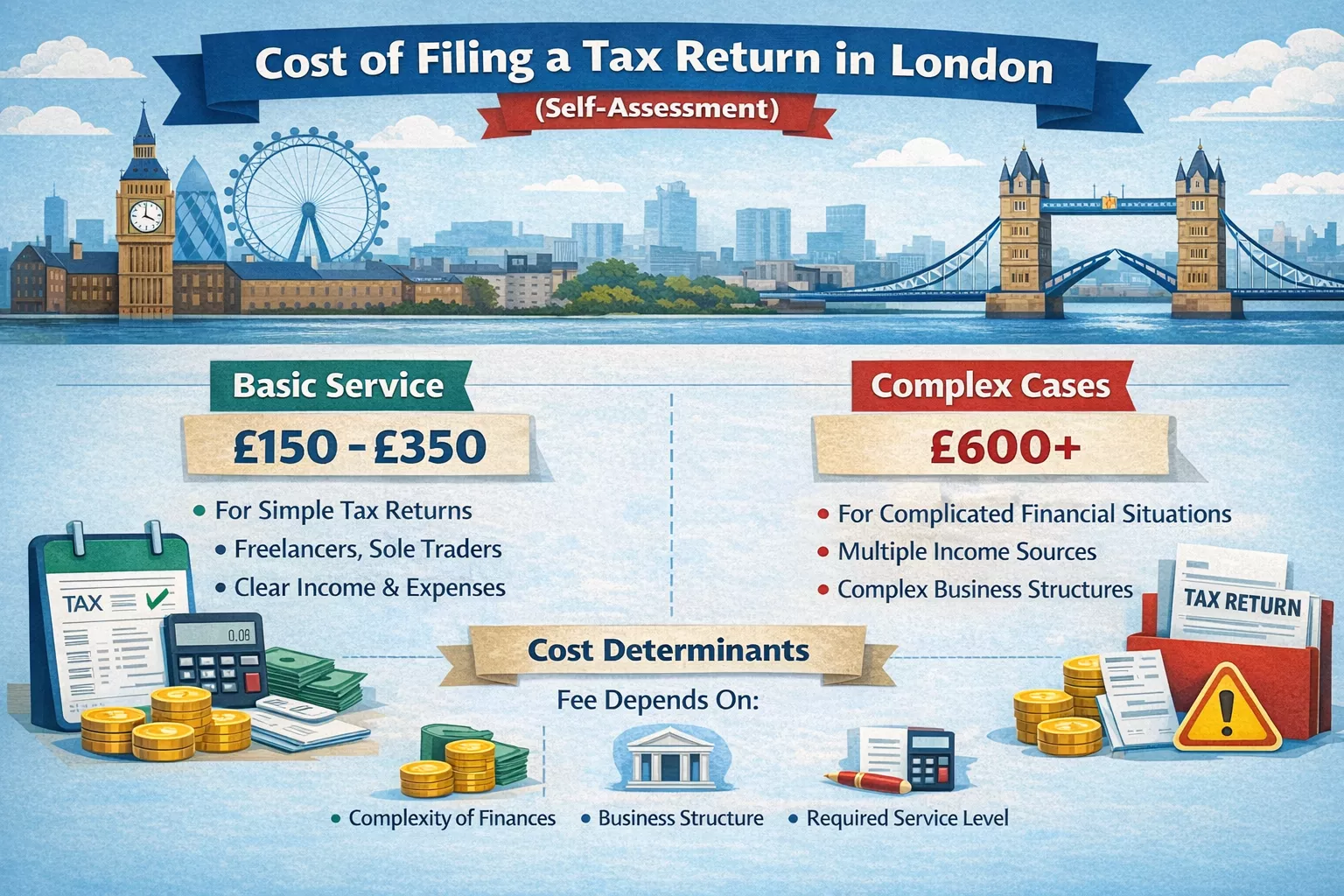
The common service options and associated costs are primarily determined by the complexity of your finances, the business structure, and the level of service required. For simple tax returns, such as those filed by freelancers or sole traders with clear income and expenses, the majority of UK accountants charge within the £150 to £350 range for a basic filing in 2025. However, an accountant will charge a significantly higher one-off fee, potentially up to £600 or more, when dealing with complex financial situations that require greater scope and detail, such as varied types of income or complicated business structures.
What penalties and interest apply for late or incorrect tax return filing?
The penalties and interest that apply for late or incorrect tax return filing are generally charged by HM Revenue & Customs (HMRC) when a taxpayer fails to comply with a tax obligation.
HMRC might charge a penalty specifically for the late filing of returns and paperwork or late payment. The penalties applied for these infractions can differ according to which specific tax you are dealing with. Additionally, if you are late in paying tax (or a penalty), HMRC will charge interest on the outstanding amount owed. To avoid being charged this interest, such as on a Self Assessment tax bill, you should pay the amount as soon as possible.
How do HMRC enquiries and audits affect London taxpayers?
HMRC enquiries and audits affect London taxpayers (and UK taxpayers generally) by creating significant stress, introducing procedural complexity, and imposing substantial financial penalties in cases of non-compliance. Being the subject of an HM Revenue and Customs tax investigation is stressful, and the varying nature of the compliance checks adds complexity to the process, which external stakeholders note can create uncertainty, undermine trust and willingness to comply, and result in the perception of unfair outcomes.
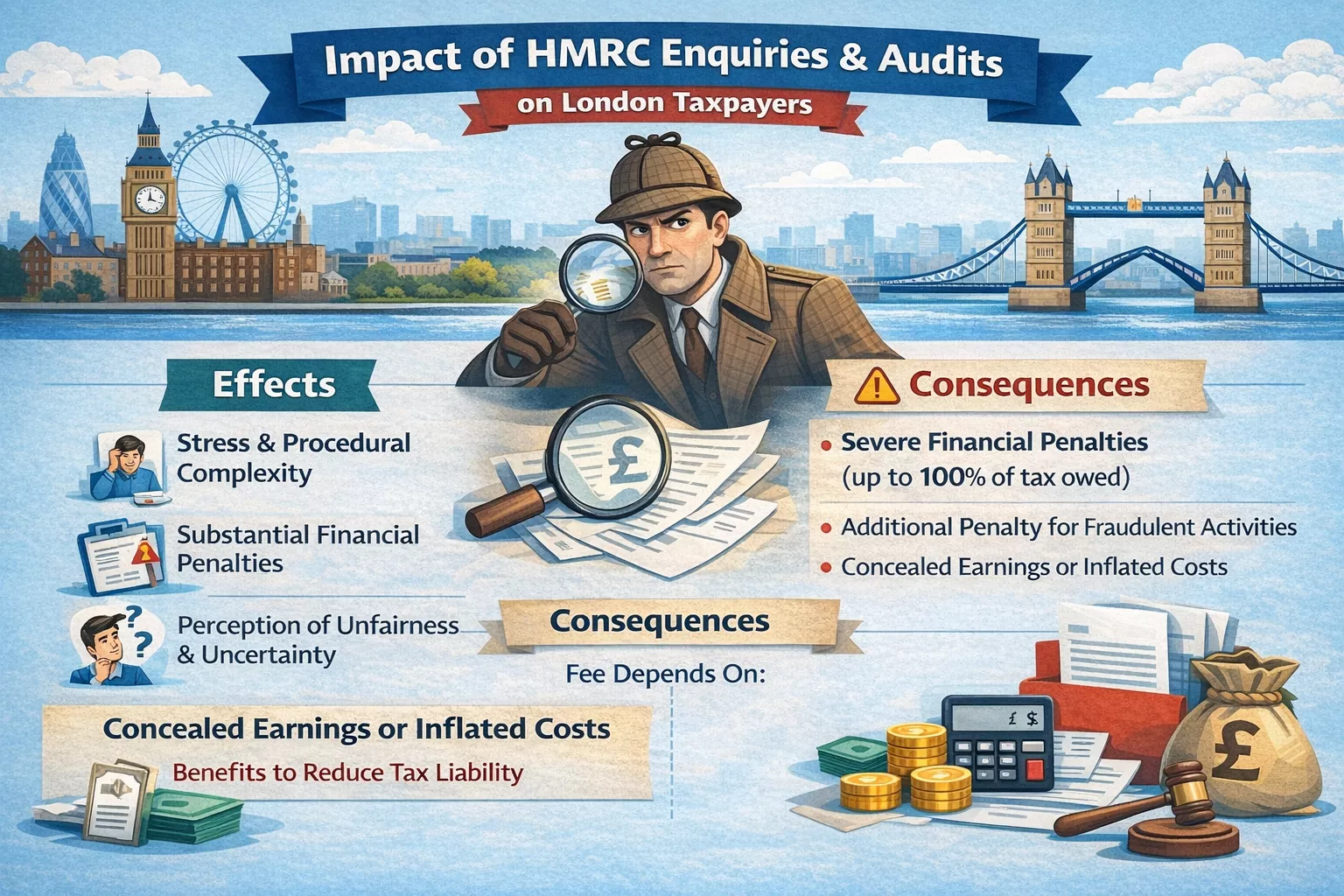
The most severe consequences, particularly for self-employed individuals, involve significant financial penalties resulting from deliberate concealment of earnings or the fraudulent inflation of costs intended to reduce tax liability. In these harsh instances, penalties of up to 100% of the tax actually owed can be charged to the taxpayer, which is levied in addition to the requirement to pay the original, correct tax bill.
How can London taxpayers correct returns or appeal penalties?
London taxpayers can correct returns or appeal penalties by formally disputing the decision or penalty notice with HMRC, generally within a strict 30-day timeframe.
If you disagree with a decision regarding a direct tax (such as Income Tax, Corporation Tax, Capital Gains Tax, or National Insurance contributions) or believe a penalty has been wrongly issued, you must explain your reasoning to HMRC, asserting that the penalty is wrong or that a reasonable excuse or mitigating circumstances apply.
Appeals must generally be filed within 30 days of receiving the HMRC penalty notice or decision letter. This can be achieved by using the specific appeal form provided with the decision letter, writing directly to HMRC at the address on the letter, or sometimes online or via post.
When appealing a penalty, the submission should clearly set out the following information:
- The reasons for the late payment or filing.
- The steps taken to avoid the issue.
- Supporting documentation, such as bank statements, correspondence, or relevant medical evidence.
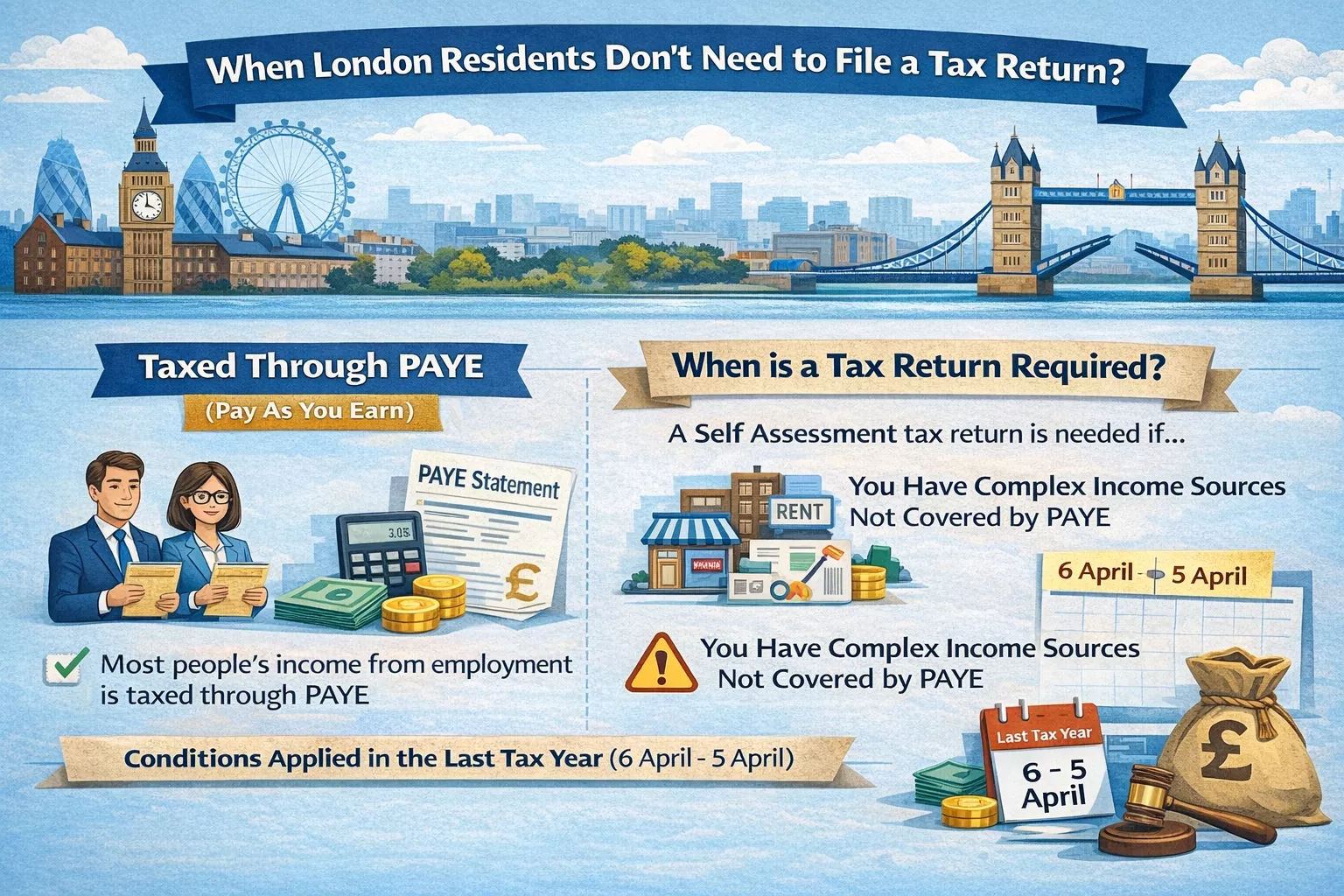
Why might some London residents not need to file a tax return?
Some London residents might not need to file a tax return because the majority of people in the UK, whose primary income is derived from employment, have their taxable income taxed directly through a system called PAYE (Pay As You Earn). Most people are only required by HMRC to submit a self-assessment tax return if specific conditions applied in the last tax year (6 April to 5 April), such as having complex income sources that are not automatically covered by the PAYE system.
How does future policy like Making Tax Digital affect London tax returns?
Future policies like Making Tax Digital (MTD) affect London tax returns, specifically for self-employed individuals and those running unincorporated property businesses (UK or abroad), by fundamentally changing how accounting records are kept and how income tax is reported to HMRC.
The mandatory start date for using MTD depends on an individual’s qualifying income within a tax year, introducing phased implementation:
- If qualifying income is over £50,000 (based on the 2024 to 2025 tax year), MTD usage will be required starting from 6 April 2026.
- If qualifying income is over £30,000 (based on the 2025 to 2026 tax year), MTD usage will be required starting from 6 April 2027.
- The government has also set out plans to introduce legislation to lower the qualifying income threshold to £20,000 for the 2026 to 2027 tax year.
Under the requirements of MTD, individuals who are subject to income tax on the profits of their trade, profession, vocation, or property business will be required to keep their accounting records electronically (using suitable software or a spreadsheet). They must then file quarterly returns to HMRC detailing their income and expenditure, along with any other specified information, before submitting a final digital tax return after the tax year to finalise their overall tax position.
Can you get help and support for tax returns in London?
Help and support for tax returns is available for individuals needing practical assistance, especially for those who cannot afford to pay for professional advice. This support addresses general difficulties in understanding tax issues, such as tax returns, allowances, and tax codes, and provides practical guidance for completing your tax return. For anyone with tax problems, this kind of advice can help provide peace of mind.
What penalties and interest apply for late or incorrect tax return filing?
The penalties and interest that apply for late or incorrect tax return filing are generally imposed by HM Revenue & Customs (HMRC) for non-compliance, late payment, or errors on documents. HMRC might charge a penalty if a taxpayer does not comply with a tax obligation, such as late filing. Furthermore, if a taxpayer is late in paying tax (such as a Self Assessment tax bill) or a penalty, HMRC will charge interest on the outstanding amount owed until it is paid.
HMRC will also charge a penalty if a taxpayer sends in a document containing mistakes, provided the error is due to one of the following conditions:
- A lack of ‘reasonable care’ in preparing the information.
- Deliberate submission of incorrect information (such as intentionally sending incorrect data).
- A deliberate and concealed error, which means intentionally sending incorrect information and taking steps to hide the mistake.
What strategies reduce the risk of fines and accumulated interest?
The strategies that reduce the risk of fines and accumulated interest involve prompt action, transparency, and maintaining accurate compliance:
- Pay your Self Assessment tax bill as soon as possible to avoid being charged interest on the amount owed.
- Inform HMRC immediately upon becoming aware of any mistake in your tax affairs. Telling HMRC before they start an enquiry or give notice of a records inspection will substantially reduce any penalty, and cooperating fully even after an enquiry has started will result in a much lower penalty.
- Keep complete and accurate records that allow you to submit a correct tax return, and always check with your agent or HMRC to confirm the correct position if you are not sure.
How should you organise records to meet HMRC evidence requirements?
You should organise records to meet HMRC evidence requirements based on the principle of ‘reasonable care,’ which HMRC recognises must take into account a particular person’s abilities and circumstances. The fundamental expectation is that records must be kept that enable the person or business to provide a complete and accurate tax return. The sophistication of the record-keeping system required depends heavily on the complexity of the tax affairs; for example, a client with relatively straightforward tax matters may only need a simple system that is regularly updated. In contrast, a large business with complex tax affairs is expected to have a more sophisticated system that is well-managed. Additionally, exercising reasonable care also entails checking with HMRC or an adviser if there is any uncertainty regarding tax obligations.
What common mistakes should London taxpayers avoid when filing?
The common mistakes London taxpayers should avoid when filing primarily involve administrative failures and the submission of inaccurate information to HMRC.
To avoid penalties, taxpayers must ensure they do not send their required Self Assessment tax return late or pay their tax bill late. Furthermore, HMRC will charge a penalty if a submitted document contains mistakes. HMRC expects each person to keep the necessary complete and accurate records and to seek advice from an adviser or HMRC if they are unsure about a specific tax matter, recognising that ‘reasonable care’ differs based on a person’s particular abilities and circumstances.
HMRC specifically charges penalties if errors in a filed return are due to:
- A lack of reasonable care, where the standard for due diligence and record-keeping is not met.
- Deliberate action, such as intentionally sending incorrect information.
- Deliberate and concealed action, meaning the taxpayer intentionally sends incorrect information and takes steps to hide the error.


